Can you build an MMM without sellout data?
Manufacturers that only see sell-in can still measure media ROI with MMM, as long as they treat the data with the safeguards the literature has mapped.
A premise most MMMs rely on
Almost every Marketing Mix Modeling case starts from one premise: the company can see the sale to the end consumer. Retailers, e-commerces, banks and apps can. A huge share of the economy cannot: B2B2C manufacturers, which make the product, sell it to distributors and retail chains, and only then does it reach the consumer or the professional who decides the purchase.
Think of a manufacturer of pipes and fittings, paint, cement or mortar. It invests millions in media to build its brand with consumers and installers, but the sales figure that shows up in the ERP is sell-in, the revenue billed to the channel. Sellout, the store's sale to whoever actually uses the product, happens in territory the manufacturer does not control and, in most categories, cannot even buy as data.
Hence the question we often hear from marketing leaders at these companies: without sellout, can you do MMM? You can. First, though, you need to understand why sell-in is a treacherous piece of data, what the literature recommends and how the model design compensates for the missing final sale.
Why you can't simply "buy the sellout"
In grocery, pharmacy and beauty there is an entire industry of sellout panels: Scanntech, NIQ and the like capture the receipt at the checkout and sell market series. That infrastructure, however, does not cover every category. Brazilian building-materials retail has around 330 thousand fragmented points of sale, of which home centers are a small fraction, and no player has built a syndicated panel for the category. Scanntech covers supermarkets, cash-and-carry, pharma and beauty; building materials, no. GfK-NIQ serves "home improvement" only in niches such as power tools.
What does exist as a paid service, such as Mtrix (now NielsenIQ) and Implanta IT, measures sellout from the distributor to the point of sale plus inventories, but only for the contracting company's own products, in the integrated channels. It is valuable data for those who already subscribe, but it is not a market panel: there is no audited share and it is not available off the shelf. For many manufacturers, a monthly sellout series for the category simply does not exist at any price.
What the literature says about modeling with sell-in
The first thing the literature makes clear is why there is so much distrust. The seminal paper by Lee, Padmanabhan and Whang (1997) on the bullwhip effect showed that the variance of orders placed with the manufacturer is systematically larger than the variance of sales to the consumer, and that the distortion grows as you move up the chain. The causes are well known: batch ordering, rationing in times of scarcity, biased reading of demand signals and, above all, trade promotions that make the channel buy when the price is good, not when the consumer is buying.
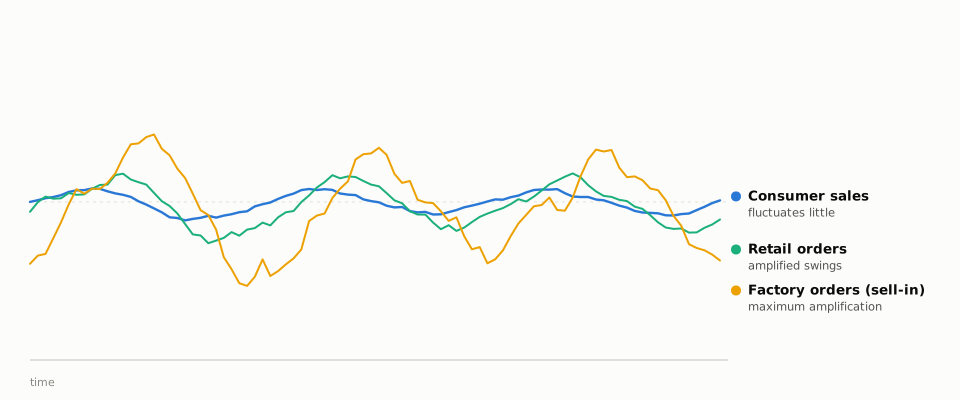
Hanssens (1998) brought this discussion into marketing territory by modeling factory orders for a consumer-durables manufacturer together with retail sales and the marketing mix. He showed that a 10% rise in consumer demand could turn into 40% swings in factory orders, and also made a practical point that explains why this article exists: in the cost hierarchy of data, orders (sell-in) are the cheapest and easiest to obtain, which is why so many manufacturers only have that data. His contribution was precisely to use econometrics to separate, within the order series, what is short-term channel movement and what is real demand trend.
In Brazil, Bessani and Bajay (2022) documented the case of the crop-protection industry, a classic B2B2C market. In the period analyzed, 37% of annual volume had sell-in below sellout, evidence that looking only at sales to the channel "can mask real demand". Their work describes the practical solution: collect distributor inventories and reconstruct sellout through the accounting identity, in which sellout equals sell-in plus the channel's opening inventory minus its closing inventory. When the manufacturer has a close relationship with a few large distributors, this reconstruction is perfectly feasible and turns a biased figure into a series much closer to demand.
Practical safeguards
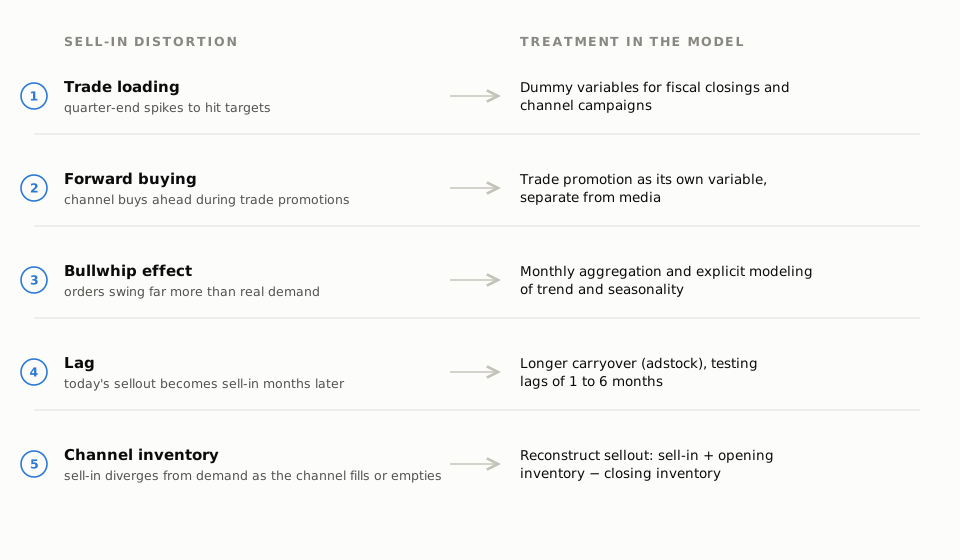
If sell-in is going to be the response variable, three phenomena need to enter the model design, because all of them create peaks and valleys that have nothing to do with media.
The first is trade loading. Near the end of the quarter, the sales team pushes volume into the channel to hit targets, inflating sell-in in the period and opening a valley right after. That pattern reflects the fiscal calendar and sales incentives, not demand.
The second is forward buying. As Desai, Koenigsberg and Purohit (2010) showed, retailers buy beyond their needs when there is a trade promotion. A good part of the sell-in spike during a commercial push is anticipation of future purchases, not incremental sales.
The third is the lag. OMP documents that the time between the sellout signal and its reflection in sell-in can reach months, because the channel burns through inventory first. The campaign generates demand today and the factory order arrives two or three months later.
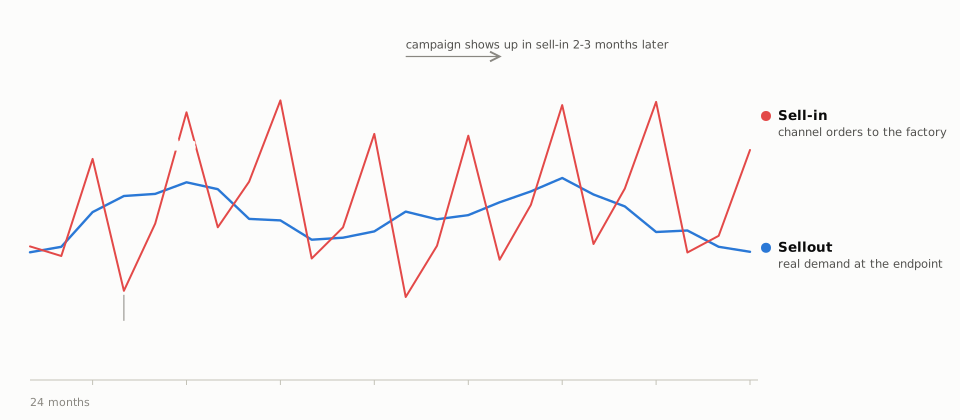
In practice, this means including trade promotions, targets and closing dates as explicit controls in the model, working with longer carryover windows than you would use with sellout (the Bayesian adstock methodology by Jin et al., from Google, was built to accommodate lags of this kind) and, whenever possible, collecting channel inventory from the main distributors to reconstruct demand, as Bessani and Bajay did.
Modern frameworks do not require sellout revenue
A common fear is that MMM tools "require" final-sale data. They do not. Google Meridian's documentation defines the KPI as the model's response variable and explicitly accepts a generic non-monetary KPI, with a conversion factor to translate the result into ROI. The official Meta Robyn guide states that the most common dependent variable is sales, but cites account openings for banks and sign-ups for telecom as legitimate alternatives. PyMC-Marketing frames the model target as "sales, new customer acquisition or any other KPI". Market practice confirms it: Measured publishes real cases with incremental orders, subscriptions and physical-store lift, Adjust runs MMM for apps with installs and in-app purchases, and Merkle recommends, for B2B without visibility of the final sale, using leads as a directional proxy with valuation applied later. A properly treated sell-in, or a reconstructed sellout, is as valid a KPI for these frameworks as any of those examples.
The public proxies that support the model in Brazil
The second pillar of the design is anchoring the model in public demand series, which help separate what is market from what is media. For building materials, Brazil offers some interesting options. IBGE's PMC survey brings revenue and volume for building-materials retail, monthly, since 2000, and is the best public proxy for channel sellout. SNIC publishes apparent cement consumption by region, a classic thermometer of construction activity. The Abramat Index tracks the deflated revenue of the sector's industry, and FGV's Construction Confidence Index anticipates the mood of the chain. Add the INCC as a deflator and the Anamaco Thermometer as a monthly read on retail. These variables enter as demand and seasonality controls, and fulfill part of the role sellout would play: telling the model when the entire market went up or down, so that media does not take credit (or blame) for the economic cycle.
So, is it possible?
It is, and there is academic and practical precedent for every piece of the design. What you cannot do is ignore the nature of the data: an MMM that treats sell-in as if it were consumer sales will attribute quarter-end spikes and trade promotions to media, and it will be wrong. A model that recognizes the bullwhip effect, controls for commercial incentives, extends carryover, reconstructs sellout wherever channel inventory is available and anchors everything in public demand proxies delivers what the CMO needs: a defensible read of how much each unit of media spend contributes to real demand, even without seeing the checkout. The absence of sellout changes the model design; it does not prevent the model from existing.
Key references
- Hanssens, D. M. (1998). Order Forecasts, Retail Sales, and the Marketing Mix for Consumer Durables. Journal of Forecasting, 17, 327-346.
- Lee, H. L.; Padmanabhan, V.; Whang, S. (1997). Information Distortion in a Supply Chain: The Bullwhip Effect. Management Science, 43(4), 546-558.
- Bessani, A. N.; Bajay, M. M. (2022). "Sell-out" como ferramenta de planejamento de vendas na indústria de defensivos agrícolas. Quaestum, 3: e2675623.
- Desai, P.; Koenigsberg, O.; Purohit, D. (2010). Forward Buying by Retailers. Journal of Marketing Research, 47(1), 90-102.
- Srinivasan, S.; Pauwels, K.; Hanssens, D.; Dekimpe, M. (2004). Do Promotions Benefit Manufacturers, Retailers, or Both? Management Science, 50(5), 617-629.
- Jin, Y. et al. (2017). Bayesian Methods for Media Mix Modeling with Carryover and Shape Effects. Google Research.
- Official documentation: Google Meridian (MMM Unified Schema), Meta Robyn (Analyst's Guide to MMM), PyMC-Marketing (Introduction to Media Mix Modeling).
- Public series: IBGE PMC (building materials), SNIC (apparent cement consumption), Abramat Index, FGV (Construction Confidence Index).